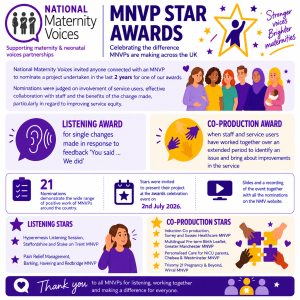
Maternity and Neonatal Voices Partnerships are making a difference to services all around the country.
We invite anyone connected with an MNVP to nominate a project undertaken in the last 2 years for one of our awards:
‘Listening’ award: for single changes made in response to feedback ‘You said ..We did’ e.g. a change in signage after a 15 steps inspection or provision of decaffeinated drinks on the postnatal ward after it was mentioned in feedback collected in the community.
‘Co-production’ award: when staff and service users have worked together over an extended period to identify an issue and bring about improvements in the service e.g. reviewing the arrangements for inductions and developing a new information leaflet about the process supporting informed decisions.
All nominations will be posted on our website to provide a positive picture of the work of MNVPs around the country. Up to 3 projects will be accepted for each MNVP. Up to 5 will be selected as stars and invited to present their project at an awards event.
Nominations will be judged on involvement of service users, effective collaboration with staff and the benefits of the change made, particularly in regard to improving service equity.
Fill in our google form to nominate a project by 30th April 2026.
The sooner you nominate, the sooner it will appear on our website!
Thanks to Natalie Whyte, former Midlands Regional Service User Voice Representative for the idea.
Nominations for the Listening Award
Project: Unconscious bias can affect care
MNVP: Bristol, North Somerset & South Gloucestershire
What? Disparities in maternity and neonatal services for under-represented groups are a significant issue, and unconscious bias can play a major role in affecting care and unintentionally shaping service users’ experiences. The MNVP used feedback and lived experiences from service users to co-produce an awareness poster that acts as a gentle but powerful visual reminder for staff to pause, reflect, listen, and act with empathy. The poster is planned for placement across maternity staff areas to encourage more inclusive, respectful, and person-centred care, focusing on growth rather than blame, with the aim of improving experiences and outcomes.
Service user involvement: The issue was identified through feedback and lived experiences shared by service users via the MNVP. Service users, including women from diverse backgrounds and those with additional needs, contributed their voices and experiences, which informed the messages used in the poster. This work was supported through MNVP engagement activities and collaboration with community voices, with consent respected at all times.
Staff involved: From the LMNS (local maternity & neonatal system)
Benefits: Early feedback has been positive from maternity staff across both trusts, the LMNS, other MNVPs, and community organisations. The poster has been welcomed as a supportive, non-blaming tool that encourages reflection and learning. While it is too early to evidence measurable outcomes, the work contributes to improving equity by centring lived experience and raising awareness of how unconscious bias can impact care for under-represented and marginalised groups. Further feedback and evaluation are planned.
Nominations for the Co-Production Award
Project: Breastfeeding Padlet
MNVP: Staffordshire & Stoke on Trent MNVP
What? Service user feedback received by the MNVP identified a lack of antenatal breastfeeding information and inconsistent postnatal support across Staffordshire and Stoke-on-Trent. Existing antenatal classes were not equitable, as they were limited to low-risk pathways, leaving a clear information gap. Following the success of a neonatal feeding Padlet, it was proposed that MNVP develop a resource for all families covering breastfeeding. The MNVP, Breastfeeding Network, and Infant Feeding Team at Royal Stoke Maternity Hospital co-produced the Padlet with staff, community teams, and service users over a period of 18 months. The Padlet is accessible to all families via QR code on personal devices or hospital iPads. Staff and community teams use QR code lanyards and posters to promote and signpost the resource. It is available in over 50 languages, with automatic translation based on device settings, alongside additional multilingual resources and provides information from finding support, how to videos, and overcoming breastfeeding challenges.
Service user involvement:The initial idea for the padlet arose following service user feedback which highlighted a gap in knowledge, support and accessible information. The MNVP held listening sessions within the local community and attended community breastfeeding groups to understand what information families specifically wanted and needed. The padlet was then designed and service users tested its functionality and approved the content.
Benefits: The padlet has improved access to consistent, high-quality infant feeding information and support for all families. Early uptake (150+ users since launch) and positive staff feedback indicate it is already enhancing both antenatal discussions and postnatal care. Staff reported strong enthusiasm at launch, highlighting the Padlet as “a valuable resource to offer women support” and “a helpful prompt for antenatal conversations.” It has also been used in clinical settings, including by obstetric staff supporting mothers with mastitis. The Padlet has improved equity, particularly for marginalised groups. Its availability in over 50 languages, with automatic translation, has enabled better support for families whose first language is not English. In addition, as it is accessible via QR code on personal devices and hospital iPads, it helps overcome barriers for those who may not be able to attend antenatal classes or access traditional services.
Project: Induction Co production project
MNVP: Surrey and Sussex Healthcare MNVP
What? In the summer of 2024 a need was identified to review and address the volume of inductions at SASH. Based on anecdotal evidence, feedback from SASH and feedback from MNVP surveys we launched a co-production into Induction. In September 2024 after 3 months of evidence gathering we gathered together and reviewed a host of key questions.
Service user involvement: Women and birthing people gave feedback, attended on the co production day and continued to be a part of our review and all of the work over 18 months.
Benefits: Since September 2025 there has been a reduction in uneccessary inductions and the overall induction rate. Key changes will launch in April 2026 to further improve and ensure equity.
Project: Induction of Labour Information Video
MNVP: Baywide MNVP (Baywide MNVP Facebook Page )
What? The MNVP Lead heard that induction of labour was not a good experience for local families a number of reasons. Service users co-produced an Induction of Labour (IOL) leaflet in 2024 with UHMBT, but there was very little impact. Families across Morecambe Bay continued to report variable experiences of induction.
Service user involvement: In 2025 the team developed an Induction of Labour survey to gather more tangible data via social media and direct to community groups and service users. Service users were also asked if they would like to get involved in an IOL stakeholder group. The stakeholder group has been working in partnership with the Consultant Midwife and In-house patient midwife Lead to develop an IOL script based on their shared experiences. These meetings have be wonderful to observe because it has provided an opportunity for all stakeholders to share their IOL experiences, and the senior midwife leads to listen to their voices, and together they have identified the best solutions that will be included in the video. The filming will be starting in March, and all the stakeholders will be using their voices to inform new mums to be about the Induction of Labour.
Benefits: The IOL stakeholder engagement has empowered so many mums, their experiences have been shared, heard, and actions have been taken to improve IOL care across Morecambe Bay. The Video will provide IOL guidance/factual information and personal experiences to support new mums to be and their families.
